
Insurance Hesitation Loops: Why Customers Delay—and How AI Breaks Them
- eCommerce AI Expert

- Feb 9
- 3 min read

Insurance buying rarely fails because customers say “no.”
More often, it fails because they say “later.”
This delay—subtle, prolonged, and often invisible—is what creates insurance hesitation loops. Customers revisit coverage options, re-check prices, abandon forms, return days later, and repeat the same evaluation cycle without progressing. From the insurer’s perspective, the intent appears weak. In reality, it is unresolved.
In the US insurance market, hesitation is especially costly. Buyers are informed, comparison-driven, and overwhelmed with choice. Auto, health, home, and life insurance decisions compete with dozens of other financial priorities. When uncertainty outweighs clarity, delay becomes the default action.
AI is uniquely suited to break these loops—not by pushing harder, but by understanding why hesitation exists in the first place.
Understanding the Insurance Hesitation Loop
Hesitation loops form when customers want protection but struggle with confidence. Insurance products are intangible, future-oriented, and risk-based. Customers are asked to commit money today for an outcome they hope never happens.
Traditional digital insurance journeys unintentionally amplify hesitation:
Long forms increase cognitive fatigue
Complex terminology creates self-doubt
Too many plan options lead to analysis paralysis
Delayed callbacks cool intent
Each pause reinforces uncertainty. The longer the loop continues, the less likely the customer is to convert.
AI breaks this pattern by intervening during hesitation—not after abandonment.
How AI Detects Hesitation Before Customers Drop Off
Unlike rule-based funnels, AI continuously observes behavioral signals across the buying journey. It doesn’t treat delay as disengagement—it treats it as a diagnostic signal.
In US insurance platforms, AI identifies hesitation through patterns such as:
Repeated visits to the same coverage sections
Form abandonment at identical steps across sessions
Pricing recalculations without submission
Long dwell times on exclusions, deductibles, or riders
Switching between similar plans without selection
These signals indicate confusion, not lack of interest.
AI uses this insight to change the experience in real time.
Breaking Hesitation with Contextual Intervention
Once hesitation is detected, AI intervenes with relevance—not pressure.
Instead of generic reminders or discounts, AI delivers clarification exactly where uncertainty exists. It reframes decisions in human terms, simplifies trade-offs, and reduces mental load.
AI breaks hesitation loops by:
Explaining coverage differences using real-world scenarios
Reducing visible options when comparison becomes counterproductive
Surfacing “most chosen” or “best fit” plans based on similar profiles
Providing instant answers to common objections without forcing calls
For US customers who value autonomy, this approach restores confidence without feeling intrusive.
The goal isn’t speed. It’s certainty.
Voice and Conversational AI in Hesitation Moments
Hesitation often peaks when customers want reassurance, not more information. This is where conversational and voice AI play a critical role.
In insurance sales and quoting journeys, voice AI detects hesitation through pauses, tone changes, and question repetition. It responds by slowing explanations, validating concerns, and clarifying next steps.
This human-like interaction reduces anxiety without transferring the customer to a live agent prematurely.
For insurers, this means fewer abandoned quotes and more confident buyers—without increasing sales headcount.
Why Traditional Follow-Ups Fail in the US Market
Human follow-ups usually arrive too late. By the time an email or call is made, the hesitation loop has already cooled intent. The customer has mentally deprioritized the decision.
AI succeeds because it operates inside the loop, not after it.
It doesn’t ask customers to restart the journey. It helps them finish the one they’re already in.
The Business Impact of Breaking Hesitation Loops
For US insurers, hesitation loops impact more than conversion rates. They affect acquisition costs, agent productivity, and long-term trust.
When AI breaks hesitation early:
Quote-to-bind ratios improve
Sales cycles shorten
Customers enter policies with higher confidence
Early churn risk decreases
Confident buyers stay longer. Hesitant buyers shop again.
From Delay to Decision
Insurance hesitation is not a failure of interest. It is a failure of clarity.
AI transforms insurance buying from a self-guided struggle into a supported decision process—without removing customer control. By detecting hesitation, responding contextually, and reducing uncertainty, AI breaks loops that humans often miss.
In the US insurance market—where choice is abundant and patience is limited—the winners will not be those who chase customers harder, but those who help them decide sooner.
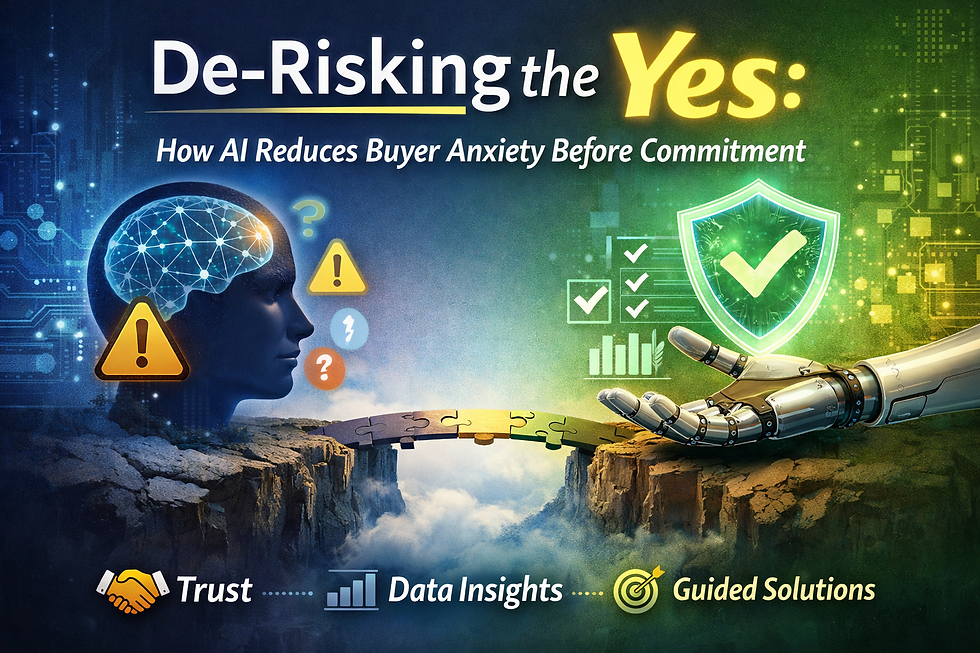
AI doesn’t force the “yes.”
It makes the “yes” feel safe.


Comments