
Customer Intent in Physical Retail: What AI Sees That Humans Miss
- eCommerce AI Expert

- 4 days ago
- 1 min read
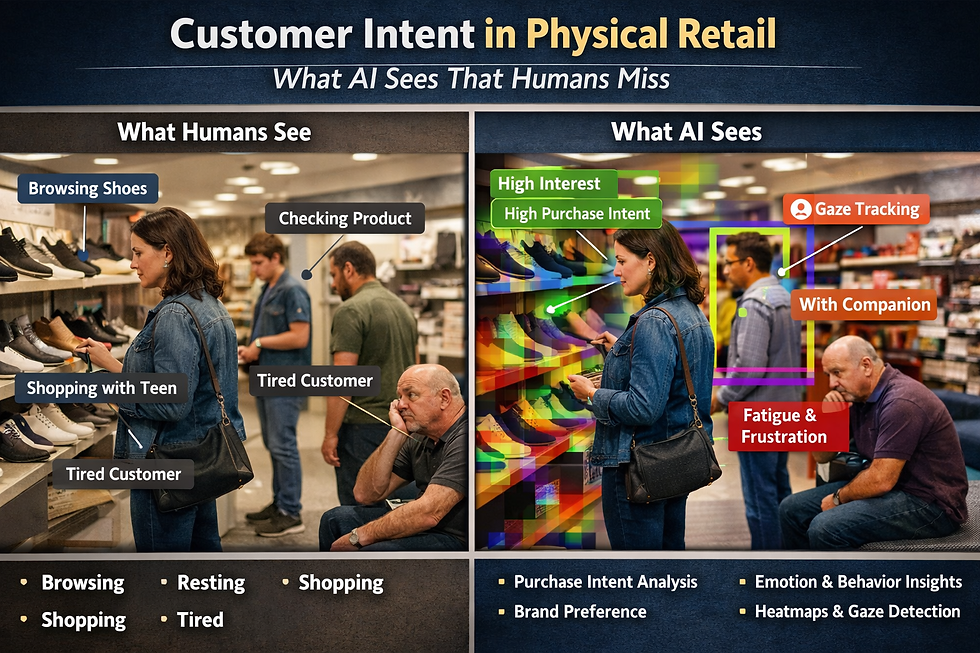
Understanding customer intent in physical retail has historically been one of the biggest blind spots in the industry. While ecommerce platforms capture rich behavioral data, brick-and-mortar stores have traditionally relied on sales outcomes rather than in-journey signals. Retail AI is now closing this visibility gap.
AI in retail uses computer vision, sensor analytics, and behavioral modeling to interpret how shoppers move, browse, and interact with products inside the store. These signals provide a far deeper understanding of intent than sales data alone.
For example, Retail AI can detect when customers repeatedly pick up a product but do not purchase, when they dwell in specific categories, or when traffic patterns suggest confusion in store layout. These insights allow retailers to optimize merchandising, staffing, and store design proactively.
AI customer support teams also benefit from this visibility. Many support complaints originate from in-store friction that was previously invisible. By identifying intent signals early, retailers can reduce the downstream burden on AI support and human service teams.
Voice AI is beginning to complement this ecosystem by enabling store managers to interact with AI agents about real-time shopper behavior. Instead of reviewing static reports, leaders can ask conversational questions about traffic flow, conversion hotspots, and customer hesitation zones.
In the highly competitive US retail environment, where physical stores must justify their existence alongside ecommerce, understanding in-store intent is critical. Retail AI provides the observational layer that human teams alone cannot scale.
The future of physical retail will not depend solely on foot traffic. It will depend on how intelligently retailers interpret what shoppers are actually trying to do.


Comments