
Conversational AI for Insurance: Simplifying Customer Communication
- eCommerce AI Expert

- 5 hours ago
- 6 min read
Introduction
Insurance communication has a clarity problem — and it is not accidental. Policies are written to be legally precise, which means they are written in language that policyholders struggle to understand. The communication that accompanies claims, renewals, and coverage changes inherits this language and amplifies it with procedural complexity. The policyholder who wants to know whether they are covered for a specific scenario, what their excess applies to, or why their premium has changed finds themselves navigating documents and communications that were designed for legal defensibility rather than genuine comprehension.
The cost of this clarity deficit is paid across the entire customer relationship. Policyholders who do not understand their coverage make poor coverage decisions. Those who cannot understand their claims correspondence do not know how to navigate the process effectively. Those who receive renewal communications they cannot parse either accept terms they should challenge or switch to a competitor they understand slightly better. Across every touchpoint, the complexity of insurance communication creates friction that erodes trust, increases contact volume, and ultimately undermines the commercial relationship between insurer and policyholder.
Conversational AI for insurance addresses this clarity problem at the communication layer — replacing complex, static documents and scripted support responses with intelligent dialogue that translates insurance complexity into plain-language interaction. The policyholder who previously needed to read a twenty-page policy document to answer a specific question can now ask the question in natural language and receive an answer that is accurate, specific to their policy, and expressed in terms they can understand.
The Communication Moments Where AI Creates the Most Value
Coverage Enquiries
Coverage enquiries are among the most frequent and most consequential customer communications in insurance. A policyholder who wants to know whether a specific situation is covered needs a clear, accurate answer — not a referral to a policy document section that uses different language from the question they asked, and not a wait for an agent to become available to look up the same information.
Conversational AI that has access to the policyholder's specific policy terms can answer coverage questions immediately, accurately, and in plain language. 'Am I covered if I have a minor car accident while driving abroad?' receives not a generic response about the insurer's products but a specific answer drawn from the policyholder's actual policy — including the relevant conditions, exclusions, and excess that apply to their specific coverage. This specificity is what makes the answer genuinely useful rather than generically informative.
The value of immediate, accurate coverage answers extends beyond the customer experience improvement. Policyholders who receive clear coverage information at the point they need it make better decisions — about whether to file a claim, whether their current coverage is adequate, and whether they need to take any action before proceeding with the activity they were enquiring about. Better-informed policyholders make fewer errors that generate costly disputes, which creates value for the insurer as well as for the customer.
Claims Navigation
The claims process is the most complex communication journey most policyholders ever undertake with their insurer. It involves multiple stages, each with its own requirements, terminology, and decision points. The policyholder who has just experienced a loss event is attempting to navigate this complexity at a moment of maximum stress, with minimal prior familiarity with the process and a strong need for clear guidance about what to do and what to expect.
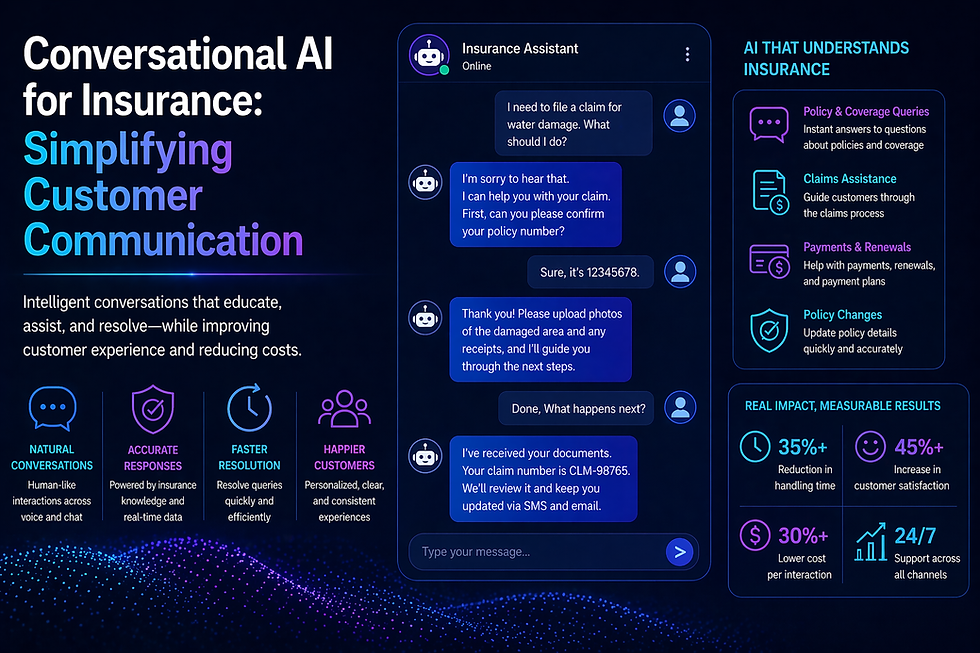
Conversational AI transforms claims navigation from a documentation exercise into a guided dialogue. Rather than receiving a claims pack to complete and return, the policyholder is walked through the process in natural language — what information is needed and why, what each stage involves, what the timeline looks like, and what to do if they encounter a specific situation. The AI can answer the questions that arise during the process — 'do I need a repair estimate before filing?' 'can I use any garage or does it have to be one of yours?' — without requiring the policyholder to call, wait, and repeat the context they have already established.
Claims navigation support through conversational AI also reduces the incomplete or incorrect submissions that generate delays and re-contact. A policyholder who is guided through what is required before they submit is less likely to omit critical information or misunderstand what the process requires — which reduces the administrative overhead of managing submissions that need to be returned for correction.
Premium and Renewal Conversations
Premium increases at renewal are among the most charged communications in the insurance customer relationship. A policyholder who receives a renewal notice showing a significant premium increase and cannot understand why — because the accompanying communication is either absent or couched in actuarial language — experiences the increase as arbitrary and potentially unfair. Their natural response is to shop the market.
Conversational AI can transform the renewal conversation from a static document into an interactive dialogue. When a policyholder asks why their premium has changed, the AI can explain the specific factors relevant to their policy — changes in claims experience in their risk category, adjustments to the actuarial model, changes in their own risk profile, or general market conditions — in language that makes the movement comprehensible rather than merely announcing it. A policyholder who understands why their premium has changed may still switch — but they are far less likely to switch from frustration at being unable to understand an inexplicable number.
Policy Changes and Mid-Term Adjustments
Life changes that affect insurance coverage — moving home, acquiring new possessions, changing vehicle, adjusting business operations — require policyholders to understand how those changes interact with their existing coverage and what adjustments are necessary. This understanding is rarely intuitive, and the communications that currently support it are often inadequate.
Conversational AI can guide policyholders through the implications of life changes for their insurance coverage in real time — explaining what needs to be updated, what the coverage and premium implications are, and completing the policy adjustment through the conversation rather than requiring the policyholder to navigate a separate system or wait for an agent. The policyholder who can say 'I'm buying a new car next week — what do I need to do?' and receive a specific, complete, actionable answer within seconds is experiencing a fundamentally different insurance communication than the one who has to find the policy update form, work out what to fill in, submit it, and wait for a confirmation.
Simplification Without Sacrificing Accuracy
The challenge in simplifying insurance communication is that accuracy cannot be sacrificed for clarity. A policyholder who receives a clear answer that is incorrect has been poorly served — potentially more poorly than one who received a complex answer they struggled with but which was accurate. Conversational AI for insurance must navigate this tension, producing responses that are genuinely comprehensible without compromising the precision that insurance communication requires.
The most effective implementations achieve this by drawing responses directly from the policyholder's specific policy data — not generating generic explanations of coverage categories but retrieving the specific terms, conditions, and limits that apply to the specific policyholder asking the question, and expressing them in plain language that preserves their meaning. The accuracy is maintained because the source is the actual policy. The clarity is achieved because the expression is plain language rather than policy language.
Where a question genuinely requires a nuance that plain language risks losing — where the precise policy wording matters legally — the AI acknowledges this and offers to provide both the plain language summary and the relevant policy extract, letting the policyholder choose the level of detail they need. This transparency about the limits of simplification is itself a trust-building mechanism.
Building Trust Through Conversational Consistency
Trust in insurance is built slowly and lost quickly. Every interaction in which the policyholder feels confused, dismissed, or misled erodes the trust that makes renewal and advocacy possible. Every interaction in which they feel genuinely informed, competently guided, and clearly served builds it.
Conversational AI contributes to trust-building through consistency — the same quality of response, the same accuracy of information, the same clarity of language across every interaction, regardless of when the policyholder contacts, through which channel, or what their previous experience with the insurer has been. This consistency is a form of reliability that insurance customers value — the confidence that the answer they receive today is as trustworthy as the one they received last month, and that they do not need to worry about which agent they were connected to or whether the person on the other end was having a good day.
Conclusion
Insurance is a product that most customers hope they will never need to use, sold through communication they find difficult to understand. Conversational AI addresses the communication dimension of this challenge directly — making it possible for policyholders to understand their coverage, navigate the claims process, comprehend their renewal, and manage their policy through natural dialogue rather than through document complexity and agent dependency.
The insurers that invest in this capability are not just improving customer satisfaction scores. They are building a communication relationship with their policyholders that creates genuine understanding of the product — which produces better coverage decisions, fewer disputes, stronger retention, and a level of trust that the current communication model rarely achieves.
Insurance that customers understand is insurance they trust. Conversational AI is the most direct path to that understanding at scale.


Comments